





Your business context, ready in PostHog
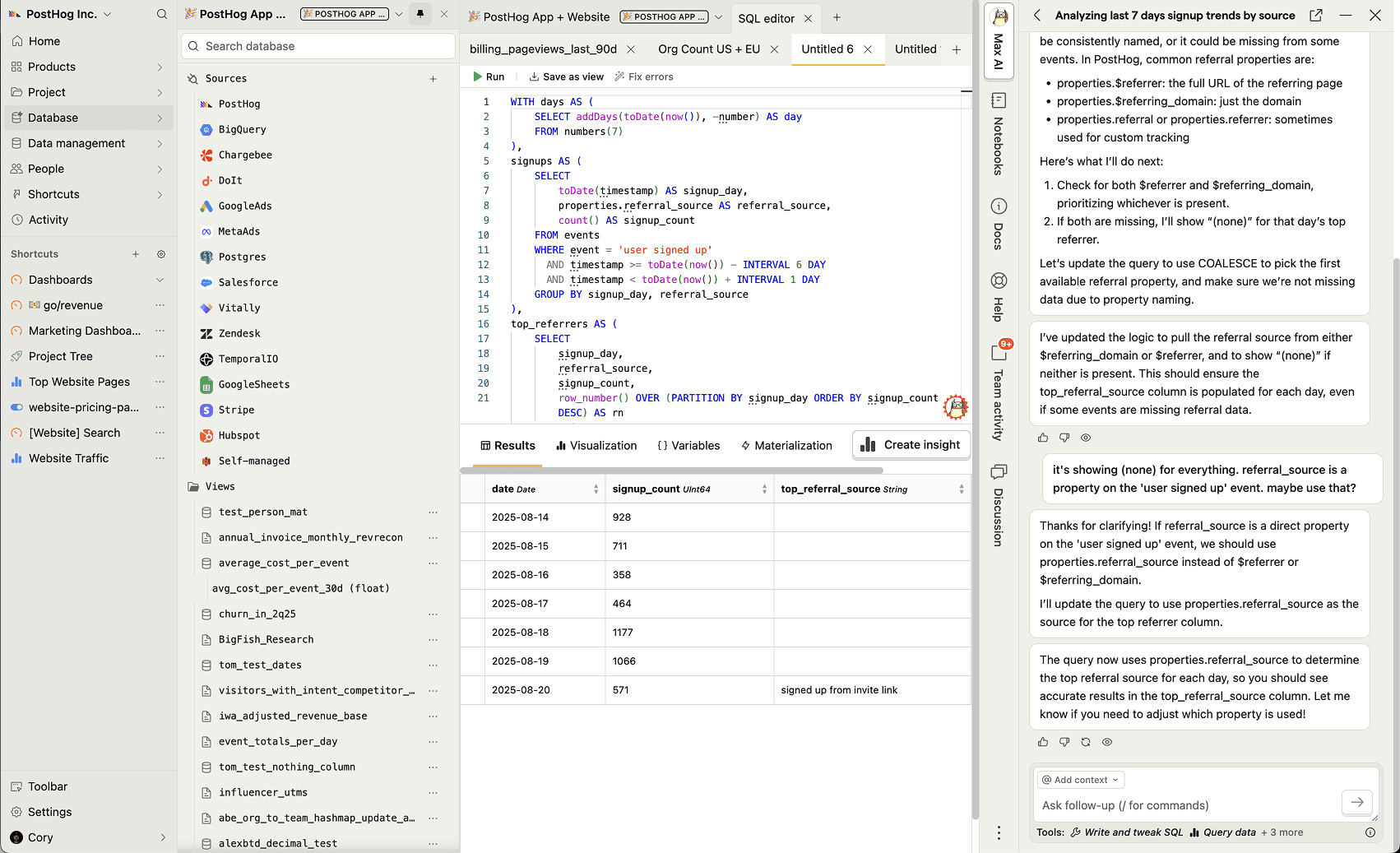
Query everything your product touches without provisioning infrastructure, writing sync jobs, or using a separate tool with PostHog's fully managed data warehouse.
A self-driving product is only as good as the data it runs on
Fragmented data = incomplete signals.
You can only act on what it can see. If your revenue data is in Stripe, your product data is in PostHog, and your CRM is somewhere else entirely, you're going to have a hard time seeing the whole picture.
The Managed Warehouse is your context layer for AI-driven product development. It's a lot more than just storage - it's what all of your PostHog tools run on. This means you're not left wondering "why did conversion drop?", but knowing "conversion in this funnel dropped, here's the revenue impact, the cohorts affected, and what those users have in common - _and_ here's a PR already open to fix the issue."
Questions worth asking
Which features drive revenue?
Join PostHog feature adoption data with Stripe subscription events. See exactly which behaviors correlate with expansion, and which ones predict churn before it happens.
Why did this experiment win for some users but not others?
Join experiment results and feature flag exposure data with your revenue source to find the segment behind the win. Build the next test around it.
Did the users who converted actually stick around?
Join funnel completion events with Stripe subscription data. See whether the users you're optimizing for are sticking around, and whether your conversion metric is measuring the right thing.
Why does this variant perform better in Europe than in the US?
Join A/B test results with revenue or demographic data from your CRM. Find the segment signal behind the regional split, and stop shipping variants that only work for half your user base.
Where does your funnel leak?
Query across signup events, CRM deal stage, and feature adoption in a single SQL statement. Get a precise answer, not a hypothesis about which step loses people and why.
Three steps to set up. One of them is clicking connect
Your PostHog data is already there
Events, persons, groups, recordings, feature flag evaluations. The moment you turn on the warehouse, PostHog starts writing to it. No config required.
Connect your external sources
Pick a source from the list. Authenticate. Done. Stripe, Postgres, Salesforce, HubSpot, S3, MongoDB, ClickHouse, they all sync on a schedule you control, with schema drift handled automatically.
Query everything, or let PostHog do it
Ask a question in plain English using Slack, PostHog Desktop or the MCP and get the answer you're looking for. Or, let PostHog's AI features use the warehouse as context when they're deciding what to surface or fix.
Built on DuckDB. Enterprise-ready on top.
DuckDB runs analytical queries fast, on hardware most teams already have. Here's what we built on top of it to get it ready for production:
Durable object storage
Data lives in S3-compatible object storage, not in-process. It survives restarts, scales horizontally, and doesn't disappear when a node does.
Automatic schema management
When your source schema changes, a new column in Stripe, a renamed field in your CRM, the warehouse detects it and adapts. No manual migrations.
Incremental sync engine
Syncs are incremental by default. For Postgres sources, we support CDC (change data capture), so you're getting row-level changes in near real time, not full table scans on a schedule.
Cross-source query routing
Queries against PostHog-native tables run close to the data. Joins across external sources are optimized at the query layer. You write the SQL you'd expect to write; we handle the execution.
Access controls and audit logging
Row-level permissions, workspace isolation, and a full audit log. Useful when your data engineer asks how the marketing team got access to the production events table.
You found it before it's finished. Nice.
The Managed Warehouse is in beta. Join the waitlist and we'll let you in as soon as it's ready. No big bang migration, no infrastructure to provision, just your data in one place.